
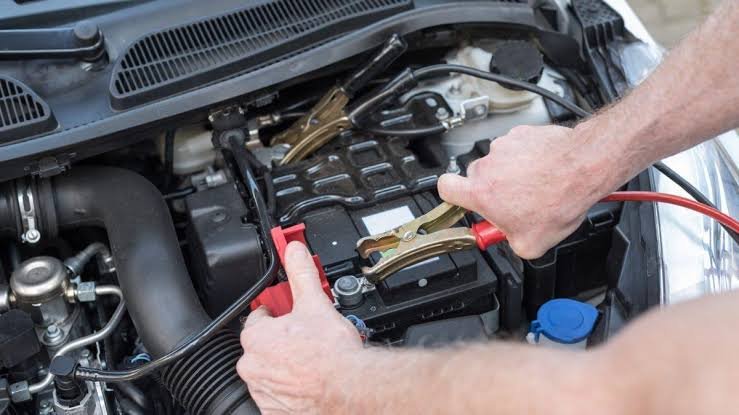

How Do You Jump Start a Car?
To jump start a car: park a working vehicle close to the dead one without letting them touch, turn off both engines, then connect jumper cables in this order — red to the dead battery’s positive terminal, red to the donor’s positive terminal, black to the donor’s negative terminal, and black to an unpainted metal surface on the dead car (not its negative terminal). Start the donor car, wait 2–3 minutes, then try starting the dead car. Disconnect the cables in reverse order once it’s running.
The sections below cover the full process, the one connection order mistake that causes most injuries, and what to do if the jump doesn’t work.
Table of Contents
What You’ll Need
| Item | Why |
|---|---|
| Jumper cables (10+ ft, 4–6 gauge) | Long, thick cables transfer current efficiently |
| A working donor vehicle | Needs a healthy 12-volt battery |
| Safety gloves and glasses | Protects against sparks and battery acid |
| Owner’s manual | Some cars hide terminals or need remote jump points |
Don’t have a second car available? A portable jump starter (battery pack) works the same way without needing a donor vehicle.
Step-by-Step Instructions
1. Position both vehicles. Park them close enough for the cables to reach, but not touching. Turn off both engines, set parking brakes, and shift into Park or Neutral.
2. Locate the battery terminals. Positive is marked (+), usually with a red cover. Negative is marked (–). Some cars — especially hybrids and European models — keep the battery in the trunk or under a seat, with remote jump points near the engine instead.
3. Connect the cables in this exact order:
- Red clamp → dead battery’s positive terminal
- Red clamp → donor battery’s positive terminal
- Black clamp → donor battery’s negative terminal
- Black clamp → an unpainted metal surface on the dead car’s engine block (not the battery itself)
4. Start the donor car. Let it run for 2–3 minutes to feed some charge into the dead battery.
5. Try starting the dead car. If it doesn’t start, wait another minute and try again. Avoid cranking for more than 5 seconds at a time.
6. Let it run. Once started, keep the engine running for at least 20 minutes (or drive it) so the alternator can recharge the battery.
7. Disconnect in reverse order. Black from the engine block, black from the donor, red from the donor, then red from the previously dead battery.
Why the Last Connection Matters
Never connect the final black clamp directly to the dead battery’s negative terminal. Batteries release hydrogen gas, especially when low, and a spark at that final connection point can ignite it. Connecting to an unpainted metal surface away from the battery keeps any spark safely away from the gas.
If the Car Still Won’t Start
- Slow or no crank at all: the battery may be too far gone to accept a jump — it likely needs replacement rather than a jump.
- Cranks but won’t fire: the issue may not be the battery at all — could be fuel, ignition, or starter-related.
- Battery is swollen, leaking, or heavily corroded: don’t attempt a jump. Call roadside assistance instead.
Frequently Asked Questions
Can jump starting damage my car’s electronics?
It’s rare with correct cable order, but connecting cables backward (reverse polarity) can damage sensitive electronics. Always double-check positive-to-positive, negative-to-negative before starting.
How long should I let the donor car run before trying to start the dead one?
2–3 minutes is usually enough to allow a first attempt.
Do I need to replace my battery after jump starting it?
Not necessarily — if the battery was simply drained (lights left on, cold weather), it should recover fully once recharged. If it keeps dying, the battery itself is likely failing.
Is it safe to jump start a car in the rain?
Avoid it if possible. If unavoidable, keep the connection points as dry as possible and wear rubber-soled shoes.
Source: AAA Oregon — Jump Starting Your Car Battery: A Safe and Easy Guide