
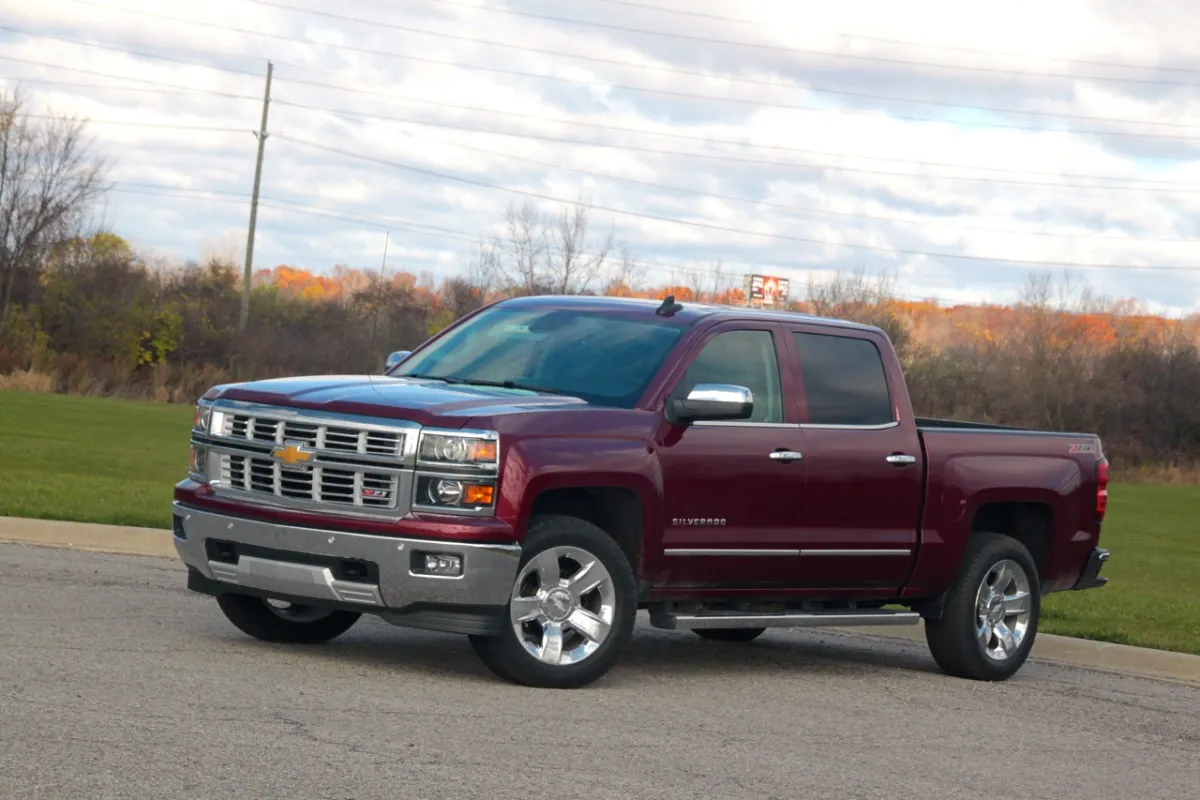

Short answer: Avoid 2007–2013 and 2014–2018 Silverado 1500s with the 5.3L or 6.2L V8, because of AFM lifter failure. Avoid 2015–2019 trucks with the 8-speed automatic, which has a separate shudder problem. And treat 2021–2024 trucks with the 6.2L V8 with real caution — those are under a recall covering roughly 600,000 vehicles for potential engine failure.
Most guides give you a single list of “bad years” and leave it there. The trouble is that those lists don’t agree with each other, and the reason is simple: the Silverado doesn’t have one problem. It has three separate problems, affecting different engines, different transmissions and different year ranges.
Once you separate them, the picture gets much clearer — and you’ll see that some years commonly recommended as “safe buys” are anything but, depending on what’s under the hood.
Table of Contents
The Three Problems, Separated
| Problem | What’s affected | Years |
|---|---|---|
| AFM/DFM lifter failure | 5.3L and 6.2L V8 | 2007 onward |
| 8-speed transmission shudder | 8L90 automatic | 2015–2019 |
| L87 connecting rod / crankshaft defect | 6.2L V8 only | 2021–2024 (recalled) |
A truck can have one of these, two of them, or none — and that depends far more on the engine and transmission combination than on the model year alone.
Problem 1: AFM Lifter Failure
Active Fuel Management shuts down four of the eight cylinders under light load to save fuel. To do that, GM fitted collapsible lifters on cylinders 1, 4, 6 and 7. Over time those lifters wear, stick, or collapse permanently.
How it progresses: a tick on cold start, then a persistent tapping, then misfire codes. If a lifter collapses fully, it damages the camshaft lobe, and metal debris circulates through the engine.
Repair cost: commonly $2,500–$4,000 for lifters and camshaft, with quotes running to $8,000 if the damage is caught late and the cam is badly worn. A remanufactured engine typically runs $5,000–$9,000 installed.
Rising oil consumption is the early warning. Owners of 2014–2021 5.3L trucks frequently report burning a quart every 1,000–2,000 miles. That’s often the same underlying issue showing itself before the tick starts.
GM replaced AFM with DFM (Dynamic Fuel Management) from 2019. DFM deactivates cylinders in more combinations rather than fewer, and lifter failures have still been reported on DFM engines — it reduced the problem rather than eliminating it.
The 4.3L V6 has no AFM at all. That’s the one engine in the lineup that sidesteps this entirely, and it’s rarely mentioned in year-based guides.
Problem 2: The 8-Speed Shudder
The 8L90 eight-speed automatic arrived as an option on V8 models for 2015 and brought its own reputation: torque converter shudder, harsh 1-2 shifts and delayed engagement.
The shudder is most noticeable at 25–45 mph under light acceleration and feels like driving over rumble strips. It’s a fluid-related issue — the original transmission fluid was prone to contamination that caused the converter to slip.
The fix is relatively cheap by transmission standards: a full fluid flush and filter change with the updated low-viscosity synthetic ATF. Many owners report the shudder disappearing entirely afterwards. If you’re looking at a 2015–2019 truck approaching 60,000 miles with no transmission service history, budget for this.
A class action highlighting harsh shifting and shudder in GM 8-speed transmissions has been filed, so this is a documented pattern rather than isolated complaints.
Problem 3: The 2021–2024 Recall Most Guides Miss
This is the one that changes the standard advice, and it’s recent enough that many “years to avoid” articles predate it.
In 2025, GM issued recall campaign N252494001 covering 2021–2024 Silverado 1500, Sierra 1500, Tahoe, Suburban, Yukon, Yukon XL and Escalade models fitted with the 6.2L L87 V8. GM’s own recall documentation states that connecting rod and/or crankshaft components may have manufacturing defects that can lead to engine damage and engine failure — and that a failure while driving causes loss of propulsion.
The scale is substantial:
- Roughly 600,000 US vehicles, including about 107,000 Silverado 1500s
- NHTSA’s report cites 28,102 complaints and 14,332 allegations of loss of propulsion
- GM identified 12 potentially related crashes
The remedy is inspection, with engine repair or replacement where needed. Trucks that pass inspection receive higher-viscosity 0W-40 oil in place of the standard 0W-20.
Why this matters for buyers: plenty of guides list 2021–2022 as the safest recent Silverado years. For a 6.2L truck, that advice is now out of date. Before buying any 2021–2024 Silverado, run the VIN through the NHTSA recall checker to confirm whether this recall has been performed on that specific truck.
A 2021–2024 truck with the 5.3L L84, the 2.7L turbo four, or the 3.0L Duramax diesel is not part of this recall.
Chevy Silverado Years to Avoid
2007–2009 — Avoid
Peak AFM lifter collapse on the 5.3L V8, plus oil consumption complaints and steering shaft clunk. CarComplaints rates 2009 among the worst model years for repair costs at relatively low mileage. These trucks are cheap now, but an AFM engine repair can exceed the truck’s value.
2014–2015 — Avoid or Inspect Heavily
The K2XX generation launched for 2014 with new EcoTec3 5.3L and 6.2L engines carrying AFM forward. 2015 added the 8L90 eight-speed, so 2015 is the first year you can get both major problems in one truck. A/C condenser failures were also common on early K2XX trucks.
2016–2018 — Inspect Carefully
Same AFM and 8-speed issues, though later builds improved. 2018 is often called the most refined K2XX year, but the underlying AFM design didn’t change.
2021–2024 with the 6.2L — Check the Recall
Covered above. Not automatically a bad truck, but you must verify the recall was completed on that VIN.
Best Chevy Silverado Years to Buy
1999–2006 (GMT800). Widely regarded as the most durable Silverado generation, largely because AFM didn’t exist yet. These are high-mileage trucks now, so condition and rust matter far more than year — inspect the frame carefully on anything from a salt-belt state.
2012. The last GMT900 year, with the AFM bugs of the late 2000s largely worked through. Frequently named the sweet spot of that generation.
2021–2022 with the 5.3L L84. Mature powertrain, modern features, outside the L87 recall, and enough inventory that you can be selective.
Any year with the 4.3L V6, if the towing capacity suits you. No AFM, no lifter issue, and usually cheaper than an equivalent V8 truck.
What to Check Before You Buy
Identify the engine first. 4.3L V6, 5.3L V8, 6.2L V8, 2.7L turbo or 3.0L diesel — this determines which problems apply. The eighth character of the VIN identifies the engine on GM vehicles, and the free NHTSA VIN decoder will confirm it.
Run the VIN for open recalls. Essential on any 2021–2024 6.2L truck, and worth doing on every used vehicle regardless.
Listen on a cold start. AFM lifter problems announce themselves as a tick before anything else. Start the truck yourself, cold, and listen for the first thirty seconds.
Check the oil level and records. Rising consumption between changes is the early stage of the same problem.
Drive it at 25–45 mph under light throttle. That’s the speed band where 8-speed shudder shows up. A short test drive around a parking lot will not reveal it.
Ask whether AFM has been deleted or lifters replaced. As with any known defect, a truck where the work has already been done and documented is genuinely lower risk than an untouched one — this is a case where a big repair in the history is a good sign.
Ask for transmission service records on any 2015–2019 truck. A fluid and filter change with the updated ATF is the single most useful thing a previous owner could have done.
Frequently Asked Questions
What years should you avoid on a Chevy Silverado?
2007–2009 and 2014–2018 with the 5.3L or 6.2L V8, because of AFM lifter failure. 2015–2019 trucks with the 8-speed automatic have a separate shudder issue. 2021–2024 trucks with the 6.2L L87 are subject to a recall for potential engine failure and need a VIN check.
Which Silverado engine is the most reliable?
The 4.3L V6 avoids AFM entirely and has the fewest reported engine issues, though it offers less power and towing capacity. Among the V8s, the 5.3L L84 in 2021 and newer trucks has a better record than the 6.2L L87 of the same period.
Is AFM delete worth doing?
Owners who have it done generally report no recurrence. Note that disabler modules alone only stop the cylinder deactivation electronically — they don’t replace the AFM lifters, so wear already underway isn’t reversed. A full mechanical delete with new lifters is the thorough fix.
Is the 2021 Silverado a good year?
With the 5.3L, yes — it’s frequently recommended. With the 6.2L, check whether the L87 recall has been completed on that specific VIN before buying.
How many miles will a Silverado last?
A well-maintained truck without AFM problems commonly reaches 200,000 miles or more. Trucks where lifter failure or oil consumption went unaddressed frequently need major engine work well before that.
What’s the most reliable Silverado generation?
The GMT800 (1999–2006) has the strongest durability reputation, mainly because it predates AFM. The trade-off is age — rust and worn suspension components matter more than any design flaw at this point.
Related Reading
- Chevy Equinox Years to Avoid — the same engine-first approach applied to Chevy’s compact SUV.
- Car Comparison Calculator — compare running costs between two trucks you’re considering.
- Fuel Cost Calculator — work out what a given MPG figure costs you per year.
Based on published NHTSA complaint and recall data, GM service documentation and owner-reported patterns. Individual vehicles vary — always have a used truck inspected by an independent mechanic and check the VIN for open recalls before purchase. Recall and litigation status can change; verify current details before relying on them. Last reviewed: September 2026.