
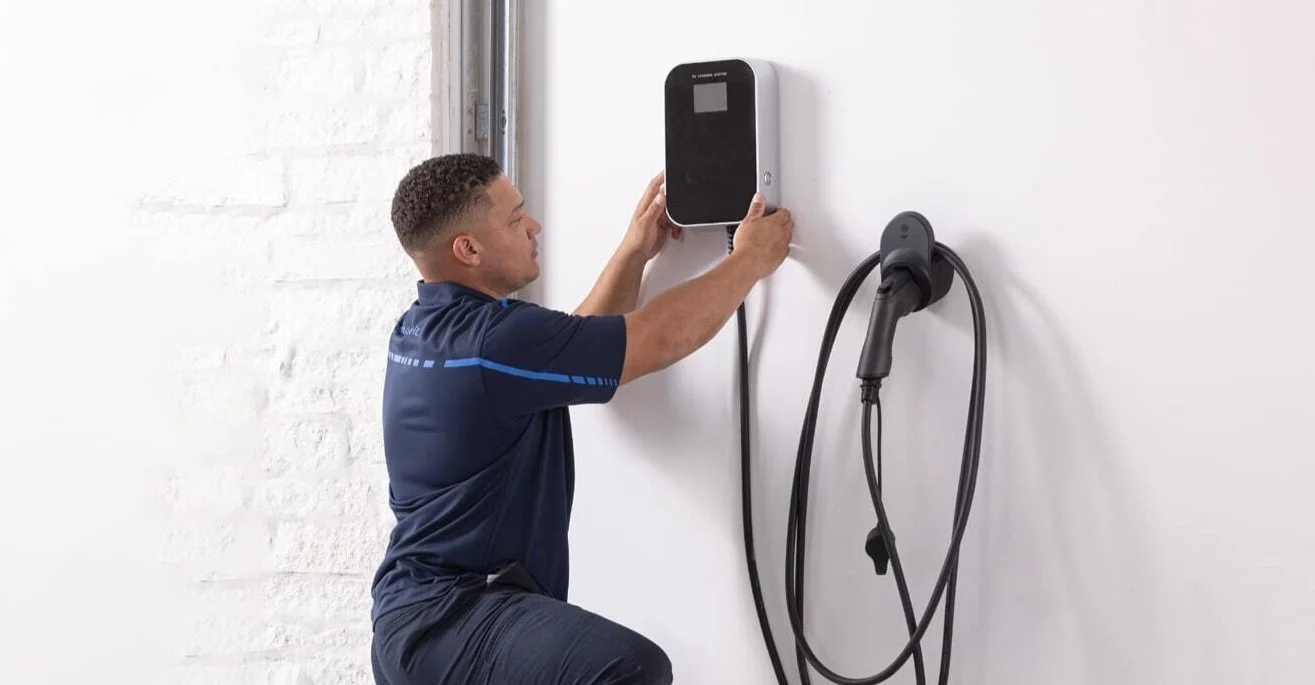

Short answer: Most homeowners pay $800 to $2,000 to have a Level 2 EV charger installed in 2026, including the charger unit, labor and permit. Simple installs can come in under $800. Jobs that need an electrical panel upgrade run $2,000 to $6,000 or more.
That’s a wide range, and the reason is worth understanding before you call anyone: you’re not really paying to install a charger. You’re paying to run a dedicated 240-volt circuit from your electrical panel to wherever you park. What that costs depends almost entirely on your house, not on the charger you pick.
What the Total Actually Breaks Down Into
| Component | Typical cost | Notes |
|---|---|---|
| Charger unit | $300 – $800 | Market range runs $100 to $800 |
| Electrician labor | $400 – $1,200 | 2 to 4 hours for a straightforward job |
| Wiring and materials | $100 – $400 | Scales with distance from the panel |
| Permit and inspection | $50 – $800 | Averages around $300 nationally |
| Panel upgrade (if needed) | $1,500 – $4,000+ | The single biggest swing factor |
Licensed electricians typically charge $80 to $150 per hour in 2026, and most have a service call minimum. A simple job — 10 to 20 feet of wire from the panel to a garage wall, a 50-amp breaker, mount the charger — takes two to four hours. A complex one can take six to ten.
Table of Contents
Simple Install vs. Complex Install
This is the distinction that determines whether you pay $900 or $4,000, and you can usually work out which one you’re in before an electrician ever visits.
Simple install — $800 to $2,000
You’re likely in this bracket if:
- Your home has 200-amp service with free breaker space
- The charger location is within about 20 feet of your electrical panel
- The install is indoors, typically an attached garage
- No trenching, drywall work or long conduit runs are needed
This describes most newer homes with an attached garage, and it’s the majority of installations.
Complex install — $2,000 to $6,000+
You’re likely here if:
- Your home has 100-amp service or a panel with no free capacity
- The panel is at the opposite end of the house from where you park
- You have a detached garage requiring underground conduit
- The charger will be mounted outdoors and needs weatherproofing
- Wire has to be fished through finished walls, attics or crawl spaces
The Panel Upgrade Question
This is where most of the surprise costs live, and it’s worth understanding properly.
A Level 2 charger on a 50-amp circuit draws a continuous 40 amps. On a 60-amp circuit, 48 amps. That’s a substantial, sustained load — comparable to adding an electric range that runs all night.
Whether your panel can handle it depends on your total existing load, not just whether there’s a free slot. An electrician performs a load calculation that accounts for your HVAC, water heater, oven, dryer and everything else before deciding.
- 200-amp panel with reasonable existing load — usually fine, no upgrade needed
- 100-amp panel, or a fully loaded 200-amp panel — may need a sub-panel ($500 to $1,500) or a full service upgrade ($1,500 to $4,000+)
There’s a middle option many homeowners don’t know about: load management devices. These monitor your home’s draw and automatically throttle the charger when other appliances are running, often avoiding a panel upgrade entirely. If an electrician quotes you a service upgrade, ask whether load management would work instead — it’s frequently cheaper.
Other Things That Push the Cost Up
- Trenching to a detached garage: $300 to $2,000+, depending on distance and what’s in the way
- Outdoor installation: adds $200 to $1,000 for weatherproof enclosures and conduit
- Long wire runs: thicker gauge wire costs more per foot, and cost rises fast past about 50 feet
- Drywall and finish work: fishing wire through finished walls adds labor, and patching afterwards may be a separate trade
Hardwired or Plug-In? It Affects the Quote
Most Level 2 chargers can either be hardwired directly into the circuit or plugged into a NEMA 14-50 outlet — the same 240-volt outlet used for electric ranges and RV hookups.
Costs are roughly similar. The plug-in route lets you swap chargers later without an electrician, and works with portable Level 2 units when travelling. Hardwiring is required for some higher-amperage chargers and is generally considered slightly more robust for permanent installation.
Ask for both to be quoted if you’re unsure — some electricians default to one without asking.
Is There Still a Tax Credit for This?
No, not federally. The Section 30C credit — worth 30% of installation cost up to $1,000 — required equipment to be placed in service before July 1, 2026. That deadline has passed, and there is no federal replacement.
Plenty of pages online still describe this credit as available. It isn’t. If you installed a charger before that date, keep your receipts and installation records, since it can still be claimed on the relevant return.
State and utility rebates are a different story, and this is where the real savings now are. Many electric utilities offer rebates specifically for home charger installation, sometimes several hundred dollars, and some offer discounted off-peak charging rates on top. Several states run their own programs.
These are worth checking before you book anything, because some require pre-approval or the use of an approved installer. Start with your own utility’s website, then check the US Department of Energy’s incentive database for your state.
For the full picture on what happened to federal EV incentives, see our guide on whether the EV tax credit is still available.
How to Avoid Overpaying
Get three quotes. Prices for identical work vary 40 to 60% within the same metro area. Three quotes usually finds the honest median.
Insist on itemized estimates. A single lump-sum number tells you nothing. Broken into labor, materials, permit and equipment, you can see what’s actually being charged for — and where there’s room to negotiate.
Get the load calculation done first. Have an electrician assess your panel before you buy a charger. Buying the unit first and then discovering you need a $3,000 service upgrade is the most common way people blow their budget.
Bundle other electrical work. If you’re already having work done, adding the EV circuit while the electrician is on site often costs meaningfully less than a separate visit.
Don’t pay a same-day premium unless you genuinely need the charger tomorrow.
Do You Even Need Level 2?
Worth asking honestly before spending anything.
Level 1 charging — the standard 120-volt outlet you already have — adds roughly 3 to 5 miles of range per hour. If your daily driving is under about 30 miles and you park overnight, that may genuinely be enough, and it costs nothing to set up.
Level 2 adds 20 to 30 miles per hour, which means a full charge overnight from almost any starting point. If you drive more than 40 miles a day, have a large battery, or share a car within the household, Level 2 stops being a convenience and starts being necessary.
Frequently Asked Questions
How much does it cost to install an EV charger at home?
Most homeowners pay $800 to $2,000 all-in for a Level 2 installation in 2026, covering the charger, labor and permit. Installs requiring a panel upgrade run $2,000 to $6,000 or more.
How long does the installation take?
A straightforward install takes two to four hours. Complex jobs involving trenching, long conduit runs or panel work can take six to ten hours, sometimes spread across two visits.
Do I need a permit to install an EV charger?
In most jurisdictions, yes — any new dedicated circuit or hardwired installation requires an electrical permit. Fees range from $50 to $800, averaging around $300. Your electrician normally pulls it, but confirm that’s included in the quote.
Do I need to upgrade my electrical panel?
Not necessarily. A 200-amp panel with free capacity typically handles a 50- or 60-amp EV circuit without changes. A 100-amp panel or a fully loaded one may need work. Only a load calculation by a licensed electrician can tell you for certain.
Can I install an EV charger myself?
Running a new 240-volt circuit is not a DIY job in most jurisdictions — it requires a licensed electrician and an inspected permit. Unpermitted electrical work can also void home insurance and cause problems when selling. Mounting a charger onto an existing, correctly-rated outlet is a different matter and is generally fine.
Is the $1,000 federal charger tax credit still available?
No. The Section 30C credit required equipment to be placed in service before July 1, 2026 and has expired. State and utility rebates may still apply.
Does the charger brand affect installation cost?
Only slightly. Amperage rating matters more than brand — a 48-amp charger needs heavier wire and a larger breaker than a 32-amp unit. Whether it’s hardwired or plug-in also affects the job slightly, but the dominant cost factors are your panel and the distance to it.
Related Reading
- Is the EV Tax Credit Still Available in 2026? — what happened to federal EV incentives and what’s left.
- Fuel Cost Calculator — compare your current fuel spend against charging costs.
- Commute Cost Calculator — work out what your daily driving costs per month and year.
Cost figures are national estimates for 2026 and vary significantly by region, home and installer. Always obtain quotes from licensed electricians for your specific property. Last reviewed: September 2026.